
Rheem’s and Rinnai’s no-hot-water checklists both start outside the water heater: power, gas, switches and supply. Five minutes of those checks can get your hot water back, and if they don’t, they tell the plumber where to start.
Everything here happens at a switchboard, a switch, a tap, a bottle or a controller. Don’t remove covers from a cylinder or gas unit: behind them are mains-voltage connections, a thermostat and gas components, and none of those are owner jobs.
What kind of hot water system do you have?
North Shore homes usually have one of four: an electric cylinder, a gas storage cylinder, a gas continuous flow unit (califont) or a heat pump water heater. The checks differ for each, so identify yours first from the unit, its label or where the pipes go. If you have two, check the one serving the cold taps.
- Electric cylinder: a tall insulated tank in a cupboard, garage or outside, with a “hot water” switch at the switchboard.
- Gas storage cylinder: similar, with a gas pipe to a control knob near the base and a flue on top. Older models keep a small pilot flame burning.
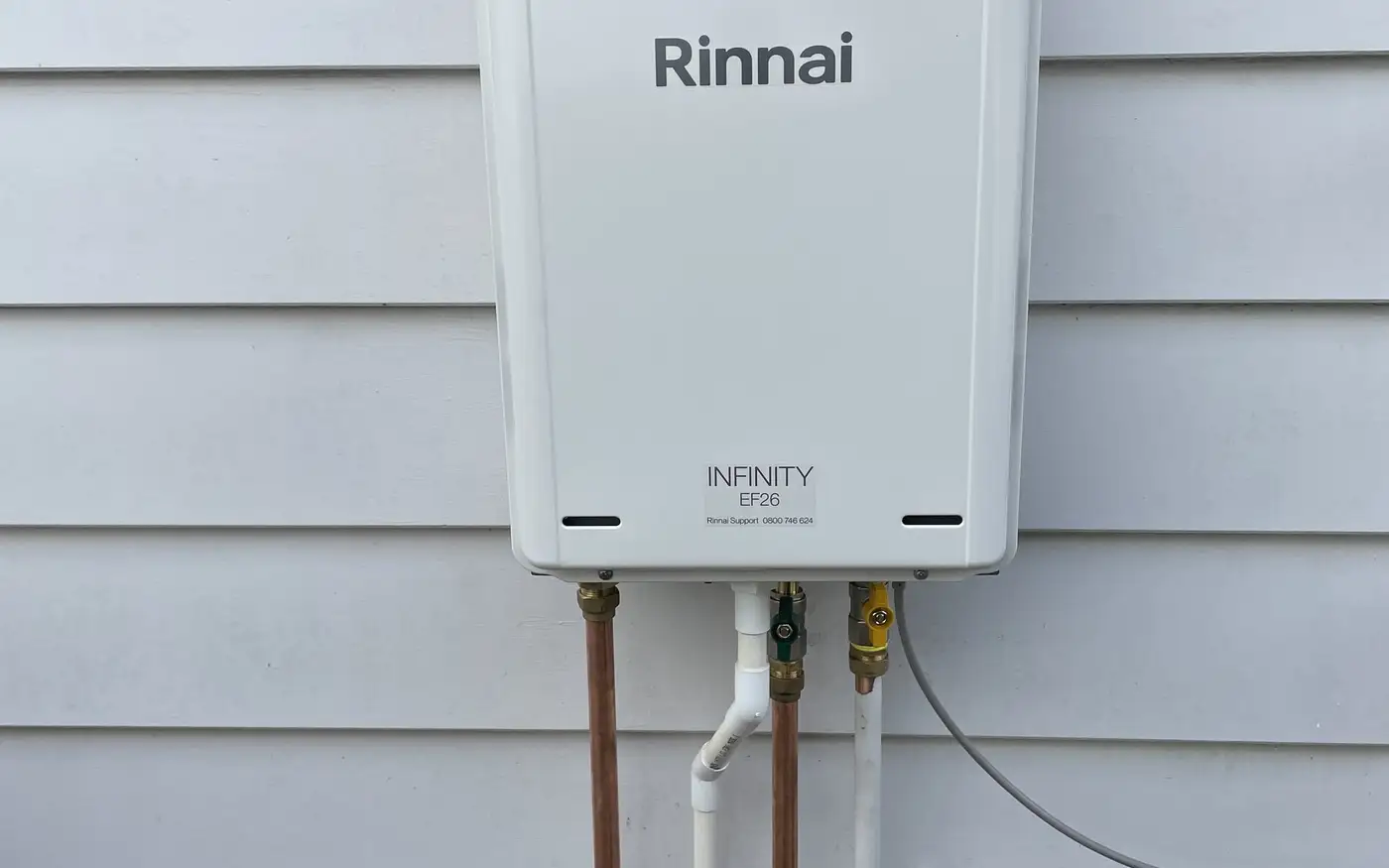
- Gas califont: a suitcase-sized box on an outside wall that fires only when a hot tap opens, usually with controllers on the wall inside.
- Heat pump: a cylinder with a fan unit on top or outside, plus a backup element.
Which checks apply to your system?
The table puts the owner checks for each system in one place, with the point to stop. The sections below explain each check. If one fixes the problem, give a storage cylinder time to reheat before judging it. Once you reach the right-hand column, stop and book a plumber, electrician or gasfitter.
| System | Check | Stop and call if |
|---|---|---|
| Electric cylinder | Hot water breaker, isolating switch, meter box switch, power cut or load control, night-rate hours | The breaker trips again, or the water is still cold six hours after power returns |
| Gas califont | Controllers on, power point, LPG bottle and changeover indicator, hot tap fully open, air in the line | An error code returns, the unit won’t ignite with gas and power on, or the RCD trips again |
| Gas storage cylinder | Pilot flame, relight per the label, gas isolation valve, another gas appliance | The pilot won’t stay lit, or you smell gas |
| Heat pump | Hot water breaker, isolating switch, timer, supply hours | The red light flashes, and there’s no hot water from the backup element either |
| Hot tap barely runs (any storage cylinder) | Cold water valve into the cylinder fully open | The valve is open and the hot side still won’t flow |
| No water at any tap | Toby at the street, Watercare outages | The street supply is on but not reaching your house |
Is it no hot water, or not enough?
Run a hot tap for a minute and watch. Cold from the start means the water isn’t being heated. Hot then cold, only warm, or barely flowing each point somewhere else, and only the first is truly no hot water. If one tap is cold and the others hot, the heater is fine and the fault is in that tap or mixer.
- Hot, then cold quickly. A storage cylinder may just be empty after heavy use; Rheem lists over-use as the first thing to rule out. If it happens daily, see how long hot water cylinders last.
- Warm, never hot. Often the tempering valve. See our guide to cylinder temperatures and tempering valves.
- Barely flowing, cold taps fine. A supply problem, not heating. See the section on the hot tap below.
What should you check first on an electric cylinder?
Check that power reaches it. Rheem’s fault guide names three places: the breaker marked “hot water” or “water heater” at the switchboard, the isolating switch beside the cylinder, and in some homes a hot water switch in the meter box outside. A tripped breaker sits off or halfway; switch it fully off, then on.
Isolating switches get knocked off during cleaning more often than you’d think. If the breaker trips again, leave it off. Rinnai’s guide puts it plainly: fuses and RCDs “do not trip out without cause”.
If everything is on and the water is still cold after a few hours, the element or thermostat has probably failed. Don’t take the cover off to press the reset button, whatever online videos suggest: the cover protects live 230 V terminals, and a cut-out that has tripped has done so for a reason.
Could the power company have switched it off?
Possibly. Most Auckland electric cylinders are on a controlled supply, which lets Vector, the lines company, pause hot water heating at peak times. Vector says this “typically affects a customer for less than three hours”, up to five across a day. The water already in the cylinder stays hot, so you may not notice.
The North Shore differs from most of Auckland. Central and south Auckland use ripple relays, which restart heating as soon as power returns. The North Shore, West Auckland and parts of Rodney use a pilot wire, a separate circuit crews must restore as well. After a big storm, Vector restores main power first, so North Shore homes can have lights and no hot water for a while. Smart meters are gradually replacing both systems.
Once heating restarts, “most household hot water cylinders will take around six hours to heat up if all the hot water has been used.” Vector’s advice: if the water still isn’t hot six hours after power returns, check the cylinder is switched on, then call Vector, because the fault may be the meter box relay or the pilot wire connection. With no power cut, the fault is at the cylinder.
On a night-rate or time-controlled tariff, Rheem notes “the supply may not be available at certain times of the day”. Your retailer can tell you the hours.
What if the hot tap barely runs, or nothing comes out?
If the cold taps run normally but the hot barely runs, water isn’t getting into or out of the cylinder. Rheem’s fault guide puts this check first: the valve on the cold pipe into the cylinder, usually just above or beside it, must be fully open. Someone may have closed it during a repair or to stop a drip.
If that valve is open and the hot side still won’t flow, a valve on the hot side has likely failed, or on an older low pressure system the feed to the cylinder may be the problem. Either way, it’s a plumbing repair.
If no tap in the house runs, check the toby (the meter and valve in a box at your street boundary) is on, then check Watercare’s website for an outage. Watercare gives five working days’ written notice of planned work and aims to restore unplanned outages within five hours. Once the supply is back, run each tap until it flows smoothly.
What should you check on a gas califont?
A califont needs power, gas and enough water flow before it fires. Work through these steps from Rinnai’s New Zealand troubleshooting guide, which apply to most continuous flow units. The most common culprit is the wall controllers: they need switching back on after every power cut, and many owners don’t know that.
- Controllers. A blank screen means press the on/off button.
- Power. The unit’s power point is often outside near it. Rinnai’s tip: plug a phone charger in to test it. If an RCD has tripped, reset it once; if it trips again, call an electrician.
- Gas. On LPG, check the bottle valves are open. With an automatic changeover valve, a red indicator means the first bottle is empty and it has switched to the second; Elgas says to leave the indicator alone and order a delivery. On natural gas, check whether the hob lights.
- Air in the line. After a bottle change or a long gap in use, turn a mixer tap to full hot and turn it on and off 10 times, check for hot water, and repeat 10 more times if needed.
- Water flow. Open the hot tap fully. After a failed ignition, the unit won’t retry until the water has stopped for a few seconds, so turn the tap off, wait, and turn it on again.
If a controller shows an error code, turn the hot tap off and on, then the controller off and on. On a Rinnai INFINITY, code 11 means no ignition or no gas supply, and code 12 means flame failure or low gas flow: check the gas is on and nothing is blocking the flue outlet. Almost every other code is a service call, so write it down for the gasfitter.
Rinnai also says LPG califonts need 45 kg bottles, because smaller bottles “freeze up” in cold weather and starve the unit. Leave the unit powered in frosty weather so its frost protection works, and have it serviced every two years.
What about a gas storage cylinder with a pilot light?
Look through the viewing opening in the front cover for the small pilot flame. If it’s out, relight it exactly as the instructions on the unit say, using only your hand on the control knob. If it won’t light, check the gas isolation valve is open and that another gas appliance works. If nothing has gas, call your gas supplier.
Two points from Rheem’s owner’s guide mean stop:
- It lights but won’t stay lit. A pilot that keeps going out usually means a failed safety device, which is a gasfitter’s repair.
- You smell gas. Don’t try to light it. Turn the control knob to off, close the gas isolation valve, leave the area and call a gas service technician.
What about a heat pump water heater?
Check the hot water breaker, the isolating switch and any timer. Two things on a heat pump look like faults but aren’t, according to Rheem’s owner’s guide. On a time-controlled tariff the unit loses power outside its supply hours, so the lights go out. And outside a band of outdoor temperatures, the backup element heats the water instead.
A flashing red light is a genuine fault. The unit switches to its backup element, so you should still have hot water while you book a service. Note how many times the light flashes.
Who should you call: electrician, plumber or gasfitter?
It depends on what failed. A dead element or thermostat needs an electrician. Valves, pipes, leaks and replacement cylinders are a plumber’s work. Anything on a gas unit beyond the owner checks needs a licensed gasfitter. If you can’t tell which, a plumber who can arrange the other trades will sort it out.
Vector’s rule of thumb is electrician for an electric cylinder with no power cut, plumber for gas. In practice the faults overlap: a cold electric cylinder can be a failed element, a failed tempering valve, or a corroded tank tripping the breaker, which is probably a replacement. We book the electrician when a job needs one. Gasfitting is restricted work, and at HW Group gas work is done and certified by our own licensed gasfitter.
What should you note before you book?
Five minutes of notes saves time on the visit:
- The system, with the brand, model and date from its label.
- What happens at the tap: no flow, cold, lukewarm, or hot then cold.
- What you checked and found: whether a breaker tripped and held, any error code or flashing pattern, whether the LPG indicator was red.
- Recent events: a power cut, storm, plumbing work or bottle change in the last day or two.
- Any water under or around the unit. If there is, read our guide to a cylinder leaking from the bottom first, because a leak changes what you should do next.
What if you rent the property out?
The landlord is responsible. Tenancy Services says the landlord must provide a way to heat water and, where gas is the main way, access to a gas supply including the bottle and piping. Tenants pay for the gas they use and should report a fault straight away. Agree in the tenancy agreement who reorders bottles.
Most no-hot-water reports from rentals turn out to be a tripped breaker, a controller left off after a power cut, or an empty bottle. Give tenants this checklist, and a tenant who has checked those and noted any error code gets a faster answer.
What we do when you call us about no hot water
We ask what you’ve checked before we come. On site, we find the cause first: the supply, the valves, the cylinder or the gas unit. If it’s a repair, we tell you what failed and how much life the unit has left. If it has reached the end, we give you the replacement options and the price in writing before we start.
See our hot water cylinder page for electric cylinders, and our gas hot water page for califonts and gas storage cylinders.