
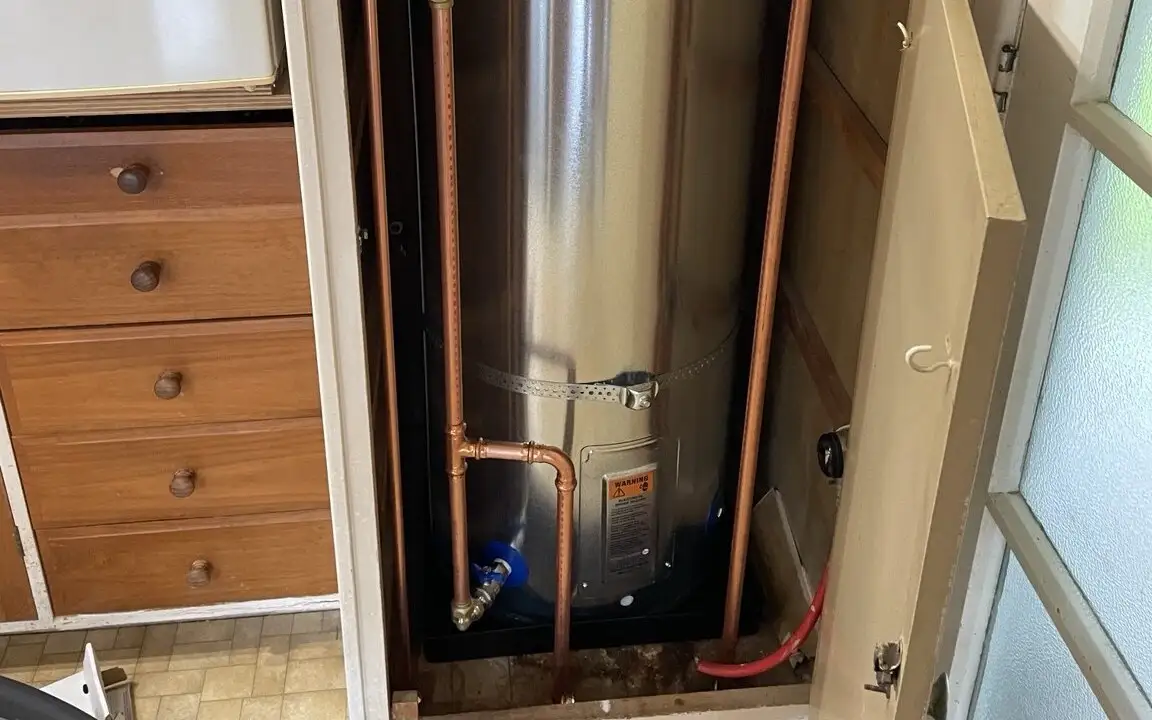
Water on the floor of the hot water cupboard means one of two things. Either a fitting somewhere on the cylinder has let go and the water is running down the outside, or the tank itself has corroded through. The first is a repair. The second is a replacement, and no amount of tightening changes that. Rheem’s own fault chart draws the same line: water around the base or in the safe tray means call a plumber; water at a connection or pipe is a plumbing repair.
This guide covers what to do in the next five minutes, how to tell which problem you have, what a repair or replacement involves, and where insurance and Watercare come in. The procedures come from Rheem and Rinnai’s New Zealand owner guides, the Building Code and the Insurance Council.
What should you do first?
- Close the cold water isolating valve. It is on the cold pipe going into the cylinder, usually just above or beside it. Turn an older tap-style valve clockwise until it stops, or give a lever valve a quarter turn. If you cannot find it or it will not move, turn the water off at the toby at the street boundary, which shuts off the whole house.
- Switch the cylinder off. At the switchboard, find the breaker or switch marked “water heater” or “hot water” and turn it off. Newer installations also have an isolating switch beside the cylinder; turn that off too. On a gas storage cylinder, close the gas isolation valve at the inlet to the gas control, or turn the control knob to off. Rheem and Rinnai both give these two steps, water and power, as the way to shut a cylinder down.
- Open a hot tap somewhere in the house for a minute to drop the pressure in the system.
- Catch the water. Towels, a tray or a bucket under the leak, and the cupboard door open so the floor can dry.
- Take photos before you mop. The puddle, the source if you can see it, and anything wet nearby. Insurers assess from evidence, and evidence gets cleaned up fast.
Do not tighten, cap or drain anything. A cylinder holds water at 60°C or more under pressure, and a fitting that is disturbed can come off altogether. Draining a cylinder is an installer’s job that involves the relief valve and a plugged drain, not a hose.
Never leave an electric cylinder switched on with the water off. An element heating an emptying tank burns out, which turns one repair into two.
Where is the water coming from?
Work from the top of the cylinder down. On an insulated cylinder, water from a fitting on top does not spray out where you would see it. It runs down between the tank and the outer casing and appears at the base, which is why so many “leaking from the bottom” calls turn out to be a fitting on top.
| Where you find it | What it usually is | Repair or replace |
|---|---|---|
| A wet fitting or union on top, water tracking down the casing | A connection, nipple or union that has worked loose or corroded | Repair |
| Water dripping from the relief or expansion valve drain outside | A valve doing its job, or one that needs replacing. See our guide to a dripping overflow pipe | Repair |
| A damp element or thermostat cover low on the side of an electric cylinder | The gasket where the element enters the tank is weeping | Repair |
| A wet cap or plug near the base | The drain outlet. New Zealand cylinders end the drain in a cap or plug, not a hose tap, so this is a fitting fault | Repair |
| The safe tray under the cylinder holding water, or its drain running outside | Something in the cupboard is leaking: one of the above, or the tank. Find which | Depends |
| A plastic drain near the bottom of a gas storage or heat pump unit dripping while it heats | Condensation. Rheem says a gas cylinder can let out several litres a day in cool weather. Not mains water | Nothing |
| Water from the body or seam of the cylinder, rust low on the casing, a damp patch that comes back after you dry it, or brown water from the hot taps | The inner tank has corroded through or cracked | Replace |
Two more checks while you are there. First, you should be able to read the rating label on the cylinder; Rheem’s installation requirements say so, and you will need it later. Second, if the pipe feeding the cylinder is black or grey plastic rather than copper, it may be Dux Quest, which fails at the fittings. Our Dux Quest guide explains how to check.
Can you still use hot water while it’s leaking?
It depends on which leak you have.
- A weep from a fitting, a valve or the element cover: yes. Use hot water as normal, keep the cupboard floor dry, and get the fitting fixed.
- Water from the tank, or a safe tray that is filling: isolate the water and the power first. You can still draw a shower from what is left in the cylinder, but the tank keeps leaking as long as it holds water, so most people isolate it and wait for the plumber.
With only the cylinder isolated, the rest of the house carries on. Cold taps, toilets and a cold wash all run from the cold supply. What you lose is hot water until the repair or replacement is done, which for most repairs is a visit of an hour or three, and for a like-for-like replacement is usually done within the day.
How long do you have?
There is no safe number, and anyone who gives you one is guessing. Two clocks are running.
The first is the house. A corroded tank only opens further, and water spreading under a floor or into a wall cavity does damage the whole time it runs. A cupboard that also holds electrical connections is not a place to leave water standing.
The second is your insurance. The Insurance Council of New Zealand’s consumer guide says that for damage to be “sudden” it has to be abrupt, all at once, or instantaneous, meaning something that happened within minutes or hours rather than days or weeks. Damage from a leak that ran for days is gradual, and gradual damage is excluded from cover apart from a capped hidden-damage benefit. In one of the Council’s case studies, a hose that leaked for four to five days was ruled gradual. Isolating the cylinder the day you find the leak is the single best thing you can do for a claim.
Repair or replace: which one is it?
| Cause | What happens |
|---|---|
| Loose or corroded union, nipple or connection on top | Refitted or replaced. The tank is fine |
| Relief, expansion or isolating valve | Replaced. Rheem and Rinnai’s guides put the relief valve on a five-year replacement interval anyway |
| Element gasket weeping | Element resealed or replaced. On a very old cylinder, disturbing the element can start the tank leaking, so we say so before touching it |
| Drain plug or cap weeping | Resealed |
| Tank cracked from a knock, often during renovations or moving boxes in the cupboard | Replacement. A cracked tank cannot be repaired |
| Tank corroded through | Replacement |
Why tanks corrode through: a mains pressure enamel cylinder is a steel tank lined with glass, with a sacrificial anode inside that is designed to corrode first. Rheem recommends having the anode inspected at eight years on a standard enamel cylinder and ten on an Optima, earlier in poor water; Rinnai says every five years. Once the anode is gone, the tank corrodes instead, and once the tank has gone there is nothing to repair. Rinnai’s own warranty scenarios say the same: a leaking inner cylinder is replaced under warranty, not patched, and the carpet it soaked is not covered.
How old is your cylinder, and does it matter?
Age does not cause a leak, but it changes the decision. A weeping union on a five-year-old cylinder is a repair. A weeping union on a twenty-year-old cylinder whose anode has never been checked is a conversation about what comes next.
Find the date on the label. Rheem, Rinnai and Dux all print the date of manufacture on the rating, data or compliance label on the outside of the cylinder, and all three use it as the warranty start date when the installation date is unknown. If the label only shows a serial number, the manufacturer’s service line can date it.
Manufacturers do not publish a lifespan. What they publish is the warranty on the tank itself:
| Cylinder type | Tank warranty (from the manufacturer’s own guide) |
|---|---|
| Rheem low pressure copper | 5 years |
| Rheem mains pressure vitreous enamel or stainless steel | 10 years (7 for enamel cylinders made before June 2018) |
| Rheem Optima | 12 years |
| Rheem Stellar gas storage | 10 years |
| Rheem heat pump | 5 to 7 years |
| Rinnai mains pressure enamel | 7 years |
| Rinnai low pressure copper | 5 years |
Plenty of cylinders run well past those figures, and the lifespans quoted online are plumbers’ estimates rather than anything the makers stand behind. The practical rule is this: a leak from the body of a cylinder that is past its tank warranty is a replacement decision, and the valves and anode are the same age as the tank.
Will insurance pay for a leaking hot water cylinder?
The cylinder itself, usually not: a worn-out tank is wear and tear. The damage it causes, often yes, if it was sudden. Here is how the policies are built, in the insurers’ own terms:
- Sudden and accidental damage is what home policies are designed for. A tank that lets go and floods the cupboard in an afternoon is the sudden case.
- Hidden gradual damage is water damage that built up over time from an internal pipe or tank and could not have been discovered immediately. Most policies pay a capped contribution for it, set out in the wording. State’s wording, for example, names “an internal tank plumbed into the water reticulation system of your home”. The benefit does not pay to find or fix the cause.
- Wear and tear, corrosion and gradual deterioration are excluded outright.
Your insurer decides which applies from a plumber’s report, so the sequence matters:
- Photograph everything before cleaning up.
- Stop the water. Insurers expect you to prevent further damage; they do not expect you to start repairs.
- Get the plumber to record what failed, why, whether it was sudden or long-running, and what was done to make it safe.
- Do not rebuild the cupboard or replace flooring before the insurer has agreed the scope. Fixing the plumbing itself is expected straight away.
Two cautions. A cylinder installed without a safe tray can count against you: the Plumbers, Gasfitters and Drainlayers Board notes that an insurer may be unwilling to cover damage where none was fitted, and Rinnai says the same in its warranty guide. And for landlords, Watercare is blunt that landlords are responsible for fixing leaks on their property; ask tenants to report damp or stains straight away, because a leak found between inspections is the gradual case.
What about the water you’ve lost?
Every litre that leaked passed through your meter first, and if it was hot you paid to heat it too. Watercare offers a partial credit on the water lost to a leak on your side of the meter, provided you fix it promptly and keep the plumber’s invoice. Our guide to water leaks and Watercare’s leak allowance explains the meter test and how to apply.
Who can replace a hot water cylinder?
A Licensed Plumber. Under the Plumbers, Gasfitters, and Drainlayers Act 2006, fixing or unfixing a sanitary appliance and the pipes that supply it is sanitary plumbing, which only a person holding a current practising licence may do. The householder exemption in the Act applies only in places the Minister has specifically designated, which does not include Auckland. Rinnai’s guides add that work by an unlicensed person voids the warranty.
The electrical connection on an electric cylinder is done by a registered electrician and certified; we arrange that as part of the job. Gas storage cylinders are connected and certified by a licensed gasfitter. Check anyone you engage on the PGDB public register. Our guide to choosing a plumber on the North Shore covers what else to look for.
What does a replacement involve, and how long does it take?
A like-for-like swap is usually done in a day, with hot water back on before we leave or by the next morning if the new cylinder heats overnight. The work is more than a swap:
- Drain and remove the old cylinder.
- Safe tray and drain. The Building Code has required a safe tray with a 40 mm drain on every new storage water heater since 2017. Many older cupboards have none. The Board’s position is that fitting one on a replacement is not always mandatory, but it recommends it, and Rheem and Rinnai’s instructions require it, so we fit one.
- Seismic restraint, so the cylinder cannot move in a quake.
- New valves: the isolating valve, tempering valve, relief and expansion valves, and a proper drain.
- The electrician’s connection, certified.
- Heat to 60°C or more, which the Building Code requires to control Legionella, and check every tap.
Building consent is not usually needed for a like-for-like replacement done by a Licensed Plumber, and we confirm the position for your cylinder before starting.
Like for like, or upgrade to mains pressure?
Replacement is the one moment the choice is free, because the cylinder is coming out either way.
Many North Shore homes built before the 1990s still have a low pressure copper cylinder fed from a header tank in the roof. BRANZ puts those systems at roughly 30 to 120 kPa. Mains pressure cylinders, the standard in newer homes and new installations, run at typically 350 to 700 kPa: stronger showers, and mixers and appliances that work as designed.
The options are:
- Same type again. The least change, the simplest job, and the right call if the pipework and tapware are old.
- Mains pressure. A different cylinder and valves, and a check of the pipework and tapware, because old pipe and old taps were not built for the pressure. If the house has Dux Quest, the pipe comes first.
- An outdoor cylinder. Frees the cupboard, and a future leak lands on the ground outside rather than on your floor.
- A heat pump unit. Needs an outdoor position and a condensate drain, and heats more slowly, but costs less to run.
We quote the routes that make sense for your house and let you choose.
What we do when we’re called to a leaking cylinder
We find the source before we quote. If the tank is sound, we repair the fitting, valve or element and tell you how much life the cylinder has left. If it isn’t, we replace it with a tray, restraint and valves to code, arrange the electrician, and give you the price in writing before we start. See our hot water cylinder page for repairs and replacements.