
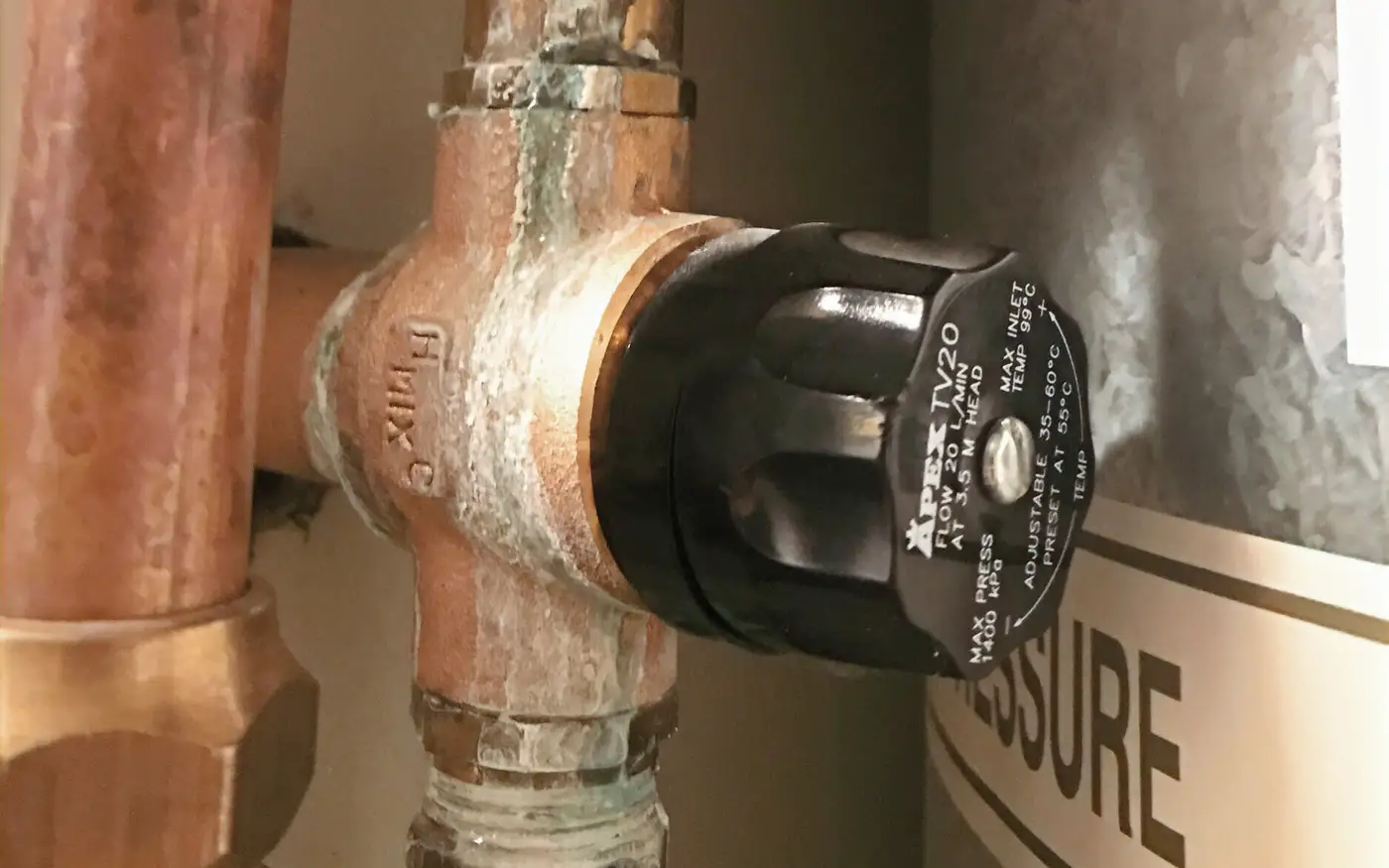
Two numbers decide how hot your water is. Water stored in the cylinder must be at least 60°C, so Legionella bacteria can’t grow in it. Water from your shower, bath and basins must be no hotter than 50°C, so it can’t scald. A tempering valve beside the cylinder turns the first number into the second. The figures below come from the Building Code’s acceptable solution G12/AS1, MBIE, BRANZ, and Rheem and Rinnai’s New Zealand owner guides.
What temperature should your hot water cylinder be set at?
At least 60°C. G12/AS1 says a storage cylinder’s thermostat “shall be set at a temperature of not less than 60°C to prevent the growth of Legionella bacteria”, whether or not a tempering valve is fitted. Installers usually set 65°C, and Rheem and Rinnai cylinders run between 60 and 70°C. Above 70°C voids Rinnai’s warranty.
Every temperature that applies in a New Zealand home:
| Where | Temperature | Source |
|---|---|---|
| Stored water in the cylinder | Not less than 60°C, reached every day | G12/AS1 6.14.3, BRANZ |
| Typical thermostat setting | 65°C (range 60 to 70°C) | Rinnai and Rheem owner guides |
| Wetback or heat pump booster | About 70°C | Rinnai, Rheem |
| Shower, bath, basin and bidet in a home, fixtures installed since 02/11/2024 | No more than 50°C | G12/AS1 6.14.1 b) |
| The same fixtures installed before 02/11/2024 | The limit was 55°C | MBIE |
| Schools, hospitals, rest homes and early childhood centres | No more than 45°C | G12/AS1 6.14.1 a) |
| Taps children can reach in an early childhood centre | No more than 40°C | Ministry of Education, quoted in G12/AS1 |
| Kitchen sink and laundry tub | No maximum; 50°C is optional | MBIE |
| A young child’s bath | 37 to 38°C | MBIE |
If the bathroom is too hot, the fix is the tempering valve, not the thermostat. Turning the cylinder below 60°C makes the stored water unsafe and, with a working valve, leaves the bathroom no cooler.
Why can’t the water at your taps be 60°C?
Because water at 60°C causes a full-thickness burn on an adult in about five seconds, and faster on a child. At 50°C the same burn takes about five minutes. That gap is the time a person needs to pull away, which is why the bathroom limit sits ten degrees below the storage minimum.
MBIE’s exposure times for adult skin, from a Danish standard:
| Water temperature | Second-degree burn | Full-thickness burn |
|---|---|---|
| 50°C | 165 seconds | 300 seconds |
| 55°C | 15 seconds | 28 seconds |
| 60°C | 2.8 seconds | 5.4 seconds |
| 65°C | 1.0 second | 2.0 seconds |
| 70°C | 0.5 seconds | 1.0 second |
For a child at 55°C, MBIE gives under four seconds to a second-degree burn and eight to a full-thickness one. Older people are at risk too, MBIE notes, because of sensitive skin, slower reactions and the chance of a fall in the shower.
What does a tempering valve do, and where is it?
It is a brass mixing valve on the hot pipe near the cylinder, with a hot inlet, a cold inlet and one outlet. A temperature-sensitive element inside adjusts the mix so the water leaving it holds at a set temperature, usually 50°C, however hot the cylinder is.
Look in the hot water cupboard or beside an outdoor cylinder for a brass body with a round plastic cap printed with the brand and temperature range, like the one in the photo above from an HW Group job. G12/AS1 calls for at least a metre of copper pipe between the cylinder and the valve, and a non-return valve on both its supplies.
Schools, hospitals and rest homes, which must hold 45°C, use thermostatic mixing valves instead. MBIE describes those as reacting faster and shutting off the hot water if the cold supply fails. A tempering valve is the right device where the limit is 50°C, which covers every home.
Why is the kitchen tap hotter than the shower?
Because the tempering valve usually feeds only the bathrooms. The 50°C limit applies to fixtures used for personal hygiene: showers, baths, basins and bidets. Kitchen sinks and laundry tubs are exempt, so they are normally piped straight from the cylinder and run at 60°C or more.
Rheem’s owner guide describes this layout: the valve keeps bathrooms below 50°C “whilst still allowing hotter water (60°C+) to the kitchen and laundry”. MBIE says tempering those to 50°C as well is optional. BRANZ notes that many dishwasher and washing machine makers require a tempered supply for their warranty when the appliance doesn’t heat its own water, so check the manual when you fit a new one.
The practical upshot: the kitchen tap is the one that can scald, so watch it with young children in the house. It also gives you the fault test below.
Does your home have to have a tempering valve?
New bathroom fixtures do. Since 02/11/2024, a shower, bath, basin or bidet installed in a home must deliver no more than 50°C, and a storage cylinder can only achieve that with a temperature control device. The rule is not retrospective, so existing fixtures can stay as they are.
- The limit used to be 55°C. The change was published in November 2023 with a 12-month transition. Watts, which makes Apex valves, cut its factory setting from 55°C to 50°C. The valve in our photo is an older Apex printed “preset at 55°C”, which was compliant when it went in.
- Older homes may have no valve at all. MBIE notes that systems installed before 1992 are unlikely to have one and recommends asking a licensed plumber about fitting one.
- Wetback and solar cylinders are stricter. No fixture or appliance may take untempered water from a cylinder with an uncontrolled heat source, because those can push the water well past the thermostat setting.
- New and replacement cylinders come with one. Rheem and Rinnai’s installation instructions both call for a temperature limiting device on a standard home installation.
For landlords, a tempering valve check fits naturally into a cylinder service between tenancies, particularly where tenants have young children.
How do you check your temperatures and spot a failing valve?
With a cooking thermometer. Run the hot tap alone at a bathroom basin until it stops getting hotter, about a minute, and hold the thermometer in the stream. Then do the same at the kitchen sink. Rinnai’s troubleshooting guide suggests this check. Compare the two readings with the table, and don’t open the cylinder or the valve.
| Bathroom | Kitchen | What it usually means |
|---|---|---|
| 45 to 50°C | Hot, 55°C or more | Working as designed |
| Above 50°C | Hot | Valve set high, an older valve preset at 55°C, or a failing valve. Worth a check, especially with children or older people in the house |
| Lukewarm or cold | Hot | The cylinder is fine and the tempering valve is the likely fault |
| As hot as the kitchen | Hot | No tempering valve on the bathroom supply, or one that has stopped mixing |
| Lukewarm or cold | Lukewarm or cold | The cylinder isn’t heating. See our no hot water checklist |
Allow a few degrees either way for the length of pipe and how long the tap has run. Two other signs point to the valve: a shower that surges hot and cold, and hot water flow that drops at the bathroom only. Scale and debris inside the valve are the usual causes, and they build up gradually.
A dripping pipe outside is a different valve: our guide to a dripping overflow pipe covers it.
Who can adjust a tempering valve or thermostat?
Not the owner. MBIE says tempering valves and other temperature control devices “must only be installed or adjusted by a licenced plumber”. The cylinder thermostat sits behind a cover over live 230 V wiring, and Rinnai says only an electrician or suitably qualified tradesperson may adjust it. Your part is the thermometer check.
- A Licensed Plumber installs, services and adjusts the tempering valve, and measures the outlet temperature afterwards.
- A registered electrician or the maker’s service agent adjusts or replaces the thermostat and element on an electric cylinder. We arrange the electrician when a job needs one.
- A licensed gasfitter works on the controls of a gas cylinder or califont.
Online videos of thermostats being turned with a screwdriver leave out that it is live electrical work, and that both settings are part of your home’s compliance.
How often should a tempering valve be serviced?
No one publishes a fixed interval. G12/AS1 says temperature control devices “require routine maintenance and performance testing” and points to the standard AS 4032.3 for the method. In practice, test it at every cylinder service. Rinnai’s schedule for its mains pressure cylinders is a full system service at year five, then every 24 months.
Some valves take replacement parts; others are sealed and replaced whole. Either way, the job ends with the outlet temperature measured and set.
What about a califont or continuous flow system?
A continuous flow gas water heater, often called a califont, stores no water, so the 60°C storage rule doesn’t apply. The 50°C bathroom limit still does. A temperature-limited model that meets AS 3498 can supply bathrooms directly, but one set above 50°C needs a separate temperature control device. See our gas hot water page.
What we do when we check your hot water temperature
We measure what comes out of your bathroom and kitchen taps before we touch anything. If there’s no tempering valve, we fit one to code with its non-return valves. If there is one, we service or replace it and set it to 50°C, and arrange the electrician for any thermostat work. You get the price before we start. If the cylinder itself is getting on, see how long hot water cylinders last, and our hot water cylinder page for repairs and replacements.