
Ask how long a califont lasts and most websites say 15 to 20 years, with no source. Rinnai and Rheem publish something more useful: warranties, sizing tables, service intervals and water quality limits. This guide uses those documents to compare a califont with a hot water cylinder for a North Shore home, then covers how long a califont lasts and when to replace one.
What is a califont, and how does it work?
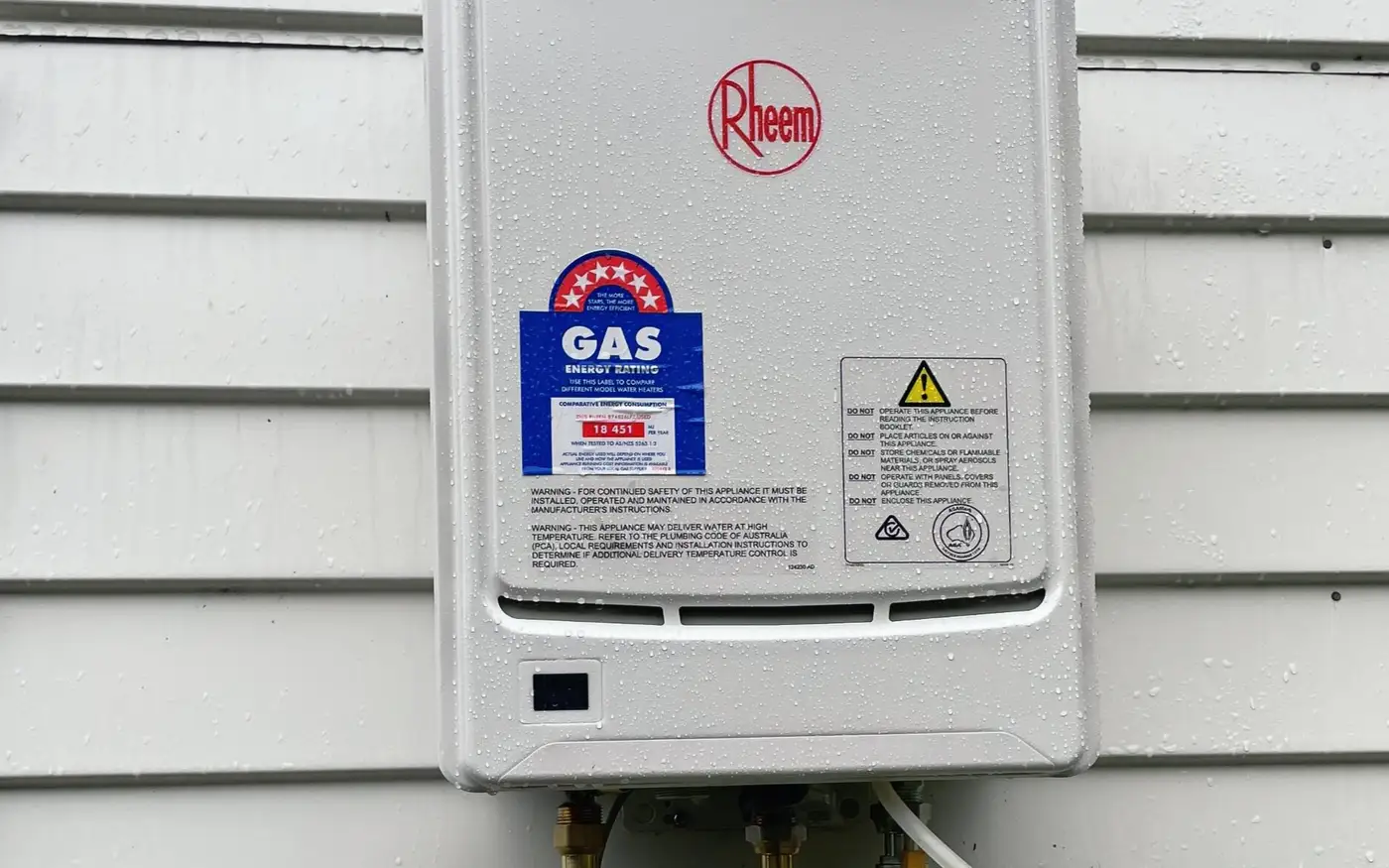
A califont is the everyday New Zealand name for a continuous flow gas water heater. It has no tank. When a hot tap opens, a flow sensor fires a gas burner, and the water heats as it passes through a heat exchanger. Close the tap and the burner stops. It runs on natural gas or LPG bottles, with a power point for its electronics.
Rinnai’s INFINITY units need about 1.5 litres a minute flowing before they fire, so a tap barely cracked open may stay cold. Most califonts are outdoor models fixed to an outside wall. Indoor models exist, but they must have their own flue to carry combustion gases outside. Rinnai puts their running noise at 50 to 54 dB(A), which matters if the only good wall is outside a bedroom.
Califont or cylinder: which suits your home?
A califont suits a household that wants hot water that never runs out, has a gas supply or room for bottles, and would like its cylinder cupboard back. A cylinder suits a house that runs several big showers at once, needs hot water through a power cut, or plans to heat water with a heat pump or solar.
| Califont (continuous flow gas) | Hot water cylinder (storage) | |
|---|---|---|
| Hot water supply | Continuous, limited by litres per minute | A fixed volume, then a wait to reheat |
| Several showers at once | Limited by the unit’s flow in winter | Limited by water pressure and the stored volume |
| Space | A box on an outside wall | A cupboard indoors, or a pad outside |
| In a power cut | Stops until power returns | Stored water stays hot for hours |
| Fuel | Natural gas or LPG | Electric, gas, heat pump or solar |
| Stored water temperature | None stored, so the 60°C rule doesn’t apply | Must reach at least 60°C |
| Firm life number | Heat exchanger warranty, 10 to 15 years | Tank warranty; see our cylinder guide |
| Servicing | Every one to five years, by brand and model | Relief valve, anode and valves on a schedule |
The fuel decision sits alongside this one. If you are weighing gas against electricity or a heat pump on running cost, read our gas vs electric hot water guide.
How big a califont does your house need?
Size it on winter flow, not the number on the box. The number is litres a minute at a 25°C rise. Rinnai uses 15°C as Auckland’s winter mains temperature, so heating to 55°C takes a 40°C rise, and an INFINITY A26 then delivers 16.3 litres a minute, not 26.
Rinnai’s own table at that 40°C rise:
- A16: 10 litres a minute.
- A20: 12.5 litres a minute.
- A26: 16.3 litres a minute.
Rheem sizes its units on a 9 litre a minute shower at 42°C. With 15°C cold water and 55°C hot, our arithmetic puts that shower’s draw at about 6 litres a minute of hot water. So an A26 runs two showers at once with room for a basin or the dishwasher, an A20 runs two showers and little else, and an A16 runs one shower and a basin.
Large rain showers, a big bath that has to fill quickly, or three bathrooms in use at seven in the morning push you to a larger unit, two units, or a cylinder. Distance matters too. Rinnai recommends siting the unit close to the most used tap, usually the kitchen, because every metre of pipe is cold water you run off before the hot arrives. Where taps are far apart, a second unit or a flow and return loop shortens the wait.
What happens to a califont in a power cut?
It stops. With no power there is no fan, no ignition and no controller, so the taps run cold until the power returns. A storage cylinder keeps the water it has already heated, so you can usually still shower during an outage. If hot water through power cuts matters to your household, it counts for a cylinder.
Two smaller effects. Rinnai’s controllers need switching back on after a power cut, a step many owners miss; our no hot water checklist covers that and the other owner checks. And both Rinnai and Rheem note that a califont’s frost protection works only while the unit has power, so leave it plugged in through winter.
Where can a califont go?
On an outside wall where combustion gases can disperse, clear of openings and meters. The gas installation standard, AS/NZS 5601.1, sets the distances from windows, doors and vents. Rinnai adds at least 1 m from a gas meter and 500 mm from an electricity meter or fuse box.
Outdoor models must never be boxed into an enclosed space, because the unit can draw back its own flue gases. A wall inside a garage, or a recess that has since been closed in, is therefore out, unless you choose an indoor model with its own flue.
On LPG, Rinnai specifies 45 kg bottles, because smaller ones can freeze up in cold weather and starve the unit. They usually go in as a pair on an automatic changeover. Bottles have their own clearances from doors, windows, vents and drains, so the gasfitter positions the bottles and the califont together.
What changes when you swap a cylinder for a califont?
The gas supply, the pipework and the power. The gas line may need upsizing for a califont’s input, or a bottle site needs planning. The hot and cold pipes are re-routed to the outside wall, and an electrician fits a weatherproof power point. The old cylinder comes out and the cupboard is yours.
Three effects owners notice afterwards:
- Water pressure. Rinnai’s external units run on mains or medium pressure supplies. In an older home moving from a low pressure cylinder, hot water arrives at mains pressure for the first time, so we check the old pipework, joints and tapware will take it.
- Temperature. Bathroom outlets keep their 50°C limit, and Rinnai ships its New Zealand A-Series preset to 50°C. Our guide to hot water temperatures explains the rules.
- Certification. Installing a califont is gasfitting, which is restricted work. At HW Group, gas work is done and certified by our own licensed gasfitter, and you get the certificate.
How long does a califont last?
No manufacturer publishes a lifespan. Rheem’s owner’s guide asks “How long will the water heater last?” and answers with its warranty and the factors that shorten it. The firm number is the heat exchanger warranty: 10 or 12 years on a Rinnai INFINITY, 10 to 15 years on Rheem models. Plan on that; anything longer is a bonus.
The heat exchanger is the expensive core of the unit, and the warranty detail matters:
- Rinnai INFINITY A-Series and EF26: 10 years on the heat exchanger, or 12 years if controllers are fitted. Other parts are covered for 3 years, or 5 with controllers. The HD and NB-Series get 12 years.
- Rheem continuous flow: its 872 series outdoor units carry heat exchanger cover to year 10 in a single-family home. Its 864 and 866 series indoor units carry it to year 15.
- The catch: after year 3, both makers cover the part, not the labour to fit it. Rinnai’s cover is pro rata, falling each year; Rheem’s 872 and 864 guides supply the replacement heat exchanger free in that period.
Rheem lists what shortens a unit’s service: “the water chemistry, the water pressure, the water temperature (inlet and outlet) and the water usage pattern.” Water chemistry is in Auckland’s favour. Watercare describes its sources as soft to moderately hard, well within the drinking water guideline, and Rinnai’s warranty requires total hardness under 200 mg/L. Tank or bore water is different: Rinnai says to test it first, and water outside its limits voids the warranty.
One more line in Rinnai’s warranty is worth knowing. Under the Consumer Guarantees Act, Rinnai guarantees spare parts and repair facilities only for the warranty period. Past it, parts for an older model are not guaranteed.
How often should a califont be serviced?
It depends on the maker and model, so follow your owner’s guide. Rinnai recommends a service every two years for a home. Rheem’s guide for its 872 series outdoor units says every 12 months, and its 864 indoor guide sets a major service every five years. Rinnai’s warranty excludes failures from improper maintenance.
Rheem lists what a service covers: checking and adjusting the gas pressure, checking and cleaning the burner, cleaning the line strainer, and inspecting the connections. Between services, Rheem’s indoor guide asks owners to keep plants trimmed back from the flue terminal. Everything else is for a licensed gasfitter.
Repair or replace an older califont?
Weigh the fault against the unit’s age. A failed sensor, igniter or fan is usually a repair, and inside the parts warranty it’s a warranty claim. A leaking heat exchanger late in its life usually means replacement: under Rinnai’s pro rata table, a unit without controllers is covered for 30% of the part in year 8, and you pay the labour.
Signs a califont is near the end: an error code that keeps returning after a service, water inside the case or dripping from it, and temperatures that swing even with the tap fully open. Before you replace like for like, check the sizing against your household now. A family that has grown since the unit went in may need the next size up, and the fuel question is worth revisiting at the same time.
What we do when you’re choosing between a califont and a cylinder
We start with the house: the gas supply, the wall a califont would go on, the pipe runs to the kitchen and bathrooms, and how many showers your household runs at once. Then we recommend one, a califont, a cylinder or both, and explain why. You get the price in writing before we start.
If your califont is getting on, we can service it and tell you honestly what life it has left. See our gas hot water page for califont installation, servicing and replacement, and our guide to how long hot water cylinders last if you are comparing the other side.